

Cold Calling 101
AI-powered cold calling is transforming B2B sales by automating prospecting, outreach, and follow-ups. Learn how to use AI in sales without losing the human touch, build better sales processes, and turn cold outreach into sustainable growth.
Greetings, dear reader. We've discussed many areas and categories of sales here before. But we haven't touched on cold calling. As a sales professional, it's something I never hesitate to do. Because at the end of the day, no matter how long the process of closing the sale takes, this customer came to the company thanks to me, and I closed the sale. If you're a sales professional, once you experience this a few times, it becomes an addictive motivational tool. Undoubtedly, it releases more dopamine than a sale you would close in your normal routine.
Sales professionals work like the founders of the company. They decide when to call their customers, how to call them, what to offer, and how to speak, creating a profile for themselves. Because this profile acts like a company founder, customers who come without any cost, without a marketing budget, are very important to them.
I was recently talking to a former colleague about a job interview process he was about to do. He said, "The job description includes cold calling, but I've never done it." “Just take the job, that's easy; I'll explain it to you, don't worry,” I said. Then I added: Why don't I publish this on my blog and website?
The reason is actually clear. Before getting into the topic, I need to mention this. We were planning to create a product of this before Claude Cowork came along. It was something my developer friend and I had been working on as a hobby in our spare time for about a year. The idea started with this: salespeople, from juniors to seniors to directors, really see this as a burden. I don't think it's a burden; that's a separate issue. They just haven't understood the source of motivation. I understand that, because it's not a strategy that yields quick and successful results. But it's definitely something that should be in sales processes. Anyway, let's not digress.
The goal we planned for our product was this: The agent we trained in the cold sales communication strategy would create lists of potential customers from our target company network using Apollo and LinkedIn. Then, they would implement our cold sales strategy, like the first touch, the second touch, and so on. Meanwhile, there are many of these products I'm talking about, even Apollo itself does it. Most of the messages you get on your LinkedIn accounts, praising you in a ridiculous way and then wanting to schedule a meeting, come from these AI tools. The difference here would have been if I had implemented my strategy, and that's how we would have differentiated ourselves with this product.
But Claude Cowork changed things. And thankfully they did. Because we were developing this product as a hobby, and it wasn't really an idea we dedicated ourselves to. We've entered the age of AI. Developing any AI-powered product as a hobby doesn't make sense. Everything can change in a day, and new products can emerge that do the same job as your product, and many different jobs. I think that's a great thing. It takes the responsibility of "Do we have to do everything ourselves?!" off our shoulders.
Cold Calling 101
I'll start explaining the cold calling process with an example. We'll go from what's done wrong to what's done right. First, we'll talk about communication. Then I'll talk about what we can do with which tools. My aim with this article is to explain that this isn't a burden and can be quickly solved with simple automation. I just want you to never forget this: Digital products, automation, robots and agents it doesn't matter. Use them only for your process. Using them for communication will never make you a successful salesperson. I've been learning, teaching, and reading as a sales professional for over ten years, and there's one thing I know very clearly: Artificial intelligence will never take the jobs of salespeople. But it will make their jobs incredibly easier. To confirm my feelings and predictions, McKinsey defines the future of sales as the "human + artificial intelligence" model. In other words, artificial intelligence won't replace the salesperson. But the salesperson who uses artificial intelligence will replace the salesperson who doesn't.*
Now let's begin.
What kind of communication should we avoid in our cold calling strategy?
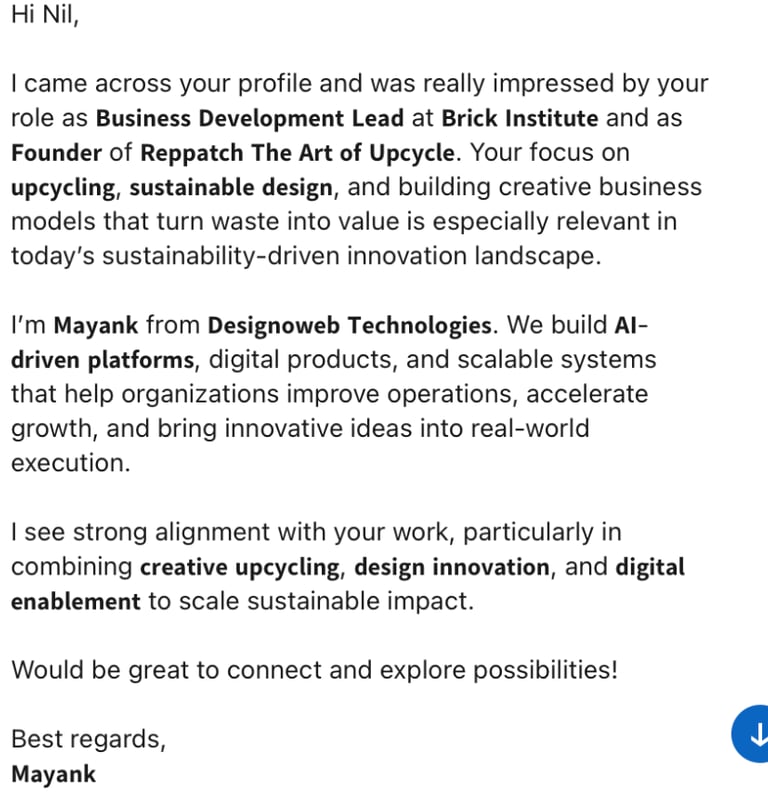
This is a LinkedIn message. This person didn't send this message themselves. An AI automation sent it. I think anyone who's read this far can easily understand this. It's very easy to see on my profile that I do two unrelated jobs simultaneously. But somehow, it establishes a connection between the two. And it praises me in an incredibly nonsensical way. In communication, praising people is a double-edged sword. You either completely attract them or you scare them away. The person who sent this message, without understanding my job, starts praising me in their very first message.
All AI tools used in sales, works with this strategy. Believe me, I've tried them. Frankly, we were going to do it differently with our product. We were going to teach the AI agent professionalism, not sincerity. Because sincerity is initiated by the salesperson; a real person initiates it, and they initiate it in a conversation where they share their energy with the relevant person. In any kind of interaction a meeting, a phone call, or face-to-face… An agent should never, ever do this. They shouldn't even try. Here, the AI agent's sole task is to send the message or email that will enable the salesperson to make this call.
And when i did not give a response, let's look at the message that sent as follow-up.
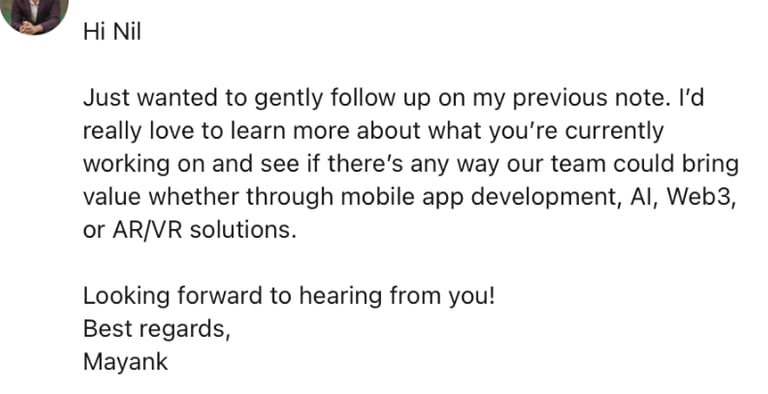
I can clearly state that I don't even understand exactly what the company this person contacted does. And he said it himselve; they develop their own AI solutions. But the AI solution they're using in this cold calling strategy is quite flawed. That is, the communication is flawed; the product is flawed; the process is flawed… And they think they can schedule a meeting with me and sell me a solution I don't need at all. The problem is, it's not a human thinking this; it's an AI agent thinking this…
When developing an agent or automation to manage the entire process from establishing communication to scheduling the meeting, you need to write perhaps thousands of prompts for control mechanisms. Because these are sensitive issues. While trying to make a sale, you could completely alienate this potential customer from your company.
Now let's move on to a positive example.
"Hello Ms. Tuğçe,
First of all, I hope everything is going well and that you've had a wonderful start to your day :)
I'm Nil, the founder of Reppatch, a multidisciplinary upcycling art atelier. I'm connecting you with potential collaborations that can create impact through my initiative, Reppatch.
We transform companies' non-recyclable clean waste into products through upcycling; we design and implement them as wholesale production or as creative and awareness-raising workshops for employees, depending on the need.
So far, we have helped hundreds of corporate employees become aware of sustainability in a creative and practical way. I am attaching a short presentation describing our projects.
I would love to have a meeting to get acquainted and discuss what we can do together. If you could share a few available days and times, I will quickly send you a calendar invite.
I look forward to hearing from you,
Best regards"
After this email, I can say that I made the biggest sale I've made in a long time. And I'm sharing this here without hesitation; any competitor of mine who has read this far in my blog is a good competitor. Let them learn, let them improve…
As I've mentioned many times on my blog, what a salesperson should do in the first contact is to talk about themselves, their company, and their product to the potential customer.* Most importantly, they should do this by building bridges. Building bridges means explaining the reason. It means using sentences that begin with, "I'm contacting you because…". So there's really no need to praise the customer or personalize your email. After you receive a response, since your sales process will truly begin, you will personalize the process specifically for your customer. In cold calling, the point is always to capture the customer's attention. You do this with your product and company, not by praising the other party.
Yes, praising is an important part of the sales process. But this should never happen in written communication or at the beginning of the communication. I sometimes did this in the first contact. In the pre-accounting software I sold for many years, our customers would come to us with a trial account. Our title wasn't salesperson, but process consultant. We were actually welcoming those who opened trial accounts.
Here, we also conducted what we call "prospecting calls," where we determined whether our customer was truly a potential customer. These phone calls lasted a maximum of 9 minutes. And when I asked the person how they kept track of their accounting process, and when they said they kept track using a notebook or Excel, I would say: "Yes, I congratulate you for managing it this way until now; but we've now moved into digitalization age, and programs like ours have truly become a necessity." I would say this sincerely because, in the digital age, being able to keep their accounting records in a notebook and run their company was truly a commendable achievement for that person. I would often praise them by explaining this. This praise would push them to make changes. Because in this way, they would truly begin to understand their needs.
I think the communication process in cold calling is clearly understood. Now let's get to the process. Things are really simple here. We're not reinventing the wheel, you know...
You start working with a tool like LinkedIn or Apollo where you can filter people by category. Next, you connect this to Claude Cowork. As a final step, you share your active customer data with Claude Cowork. You might have security concerns here, so sharing only the company name is sufficient. Then, you go to Claude Cowork's chat area and write your prompt. Your prompt should look something like this:
"I want you to create a list based on the criteria I've specified. This list should include at least two, and at most three, senior or higher-level Human Resources Department employees from each company located in Turkey, with a minimum of 100 employees and a maximum of 5,000 employees. The headings you will use in this list are: Name, Surname, Email Address, Company Name, Position, and LinkedIn Profile Link. When creating this list, be careful not to include employees from companies already on our active customer list."
You can design and further detail your prompt according to your needs. You can specify the sectors of the target companies. You can specify the length of time these individuals have worked there, and so on…
Claude will be able to easily access all this information through the tools you've connected.
Once your lists are ready, the next step is to determine the email template you will use to reach these individuals. You can use the template I shared as a successful example.
You can complete your template by mentioning yourself, your company, your product or service, building bridges (i.e., explaining why you are reaching out to this person), and closing with a clear action, i.e., a clear question.
Then, link your email address to Claude and instruct him to send a maximum of 8 personalized emails per hour, including the person's name and salutation. It's important that Claude marks each person's status as "first contact established" on your list as it sends emails. After a week, you can send a follow-up email with the subject line, "I hope I'm not bothering you. Have you had a chance to review my previous email?" Once you receive a response, you can forward the information to your sales crm and continue with the process.
My strategy here is to transfer those who respond with "We're not interested right now, but opportunities may arise in the future" to my sales crm, set up a reminder, and contact them again in a few months.
If you don't want to pay for these tools, you can do it yourself instead of having Claude do it all. Apollo provides a certain amount of free credit each month, allowing you to pull customer data based on your defined criteria.
After that, it's simple: design your own process and make it sustainable. But always keep one thing in mind: cold selling isn't quick selling. Even a customer who gives you positive feedback might be a potential sale that closes a year from now. The important thing is to repeat this process, follow up with your customers, and always believe in future opportunities.
Get our newsletter:
or directly reach out to info@nilkarul.com